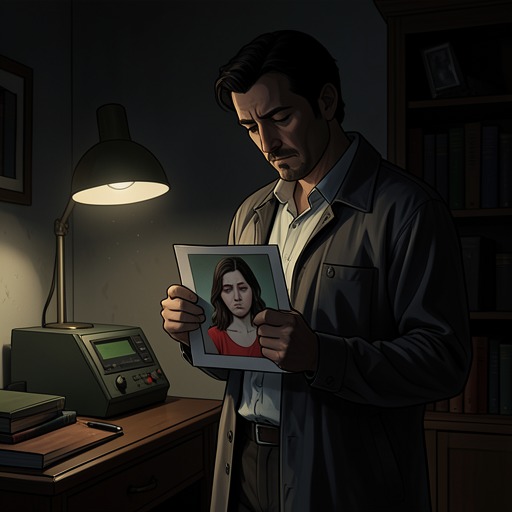
Marissa Thorpe
It Must Be Love: A Mustang Prairie RomanceMarissa Thorpe remains one of the most powerful absent figures in the story. She is remembered as a beautiful, kind, and popular woman, but her death and marriage are not treated as simple sentimental history. Through photographs, family recollections, inherited habits, and Jack Thorpe’s eventual confession, Marissa becomes both a cherished mother and wife and the unresolved center of the family’s grief, guilt, and fear of renewed intimacy.
Identity and Public Memory
Marissa Thorpe is the deceased wife of Jack Thorpe and the mother of Abby Thorpe and Andie Thorpe. Her reputation in Mustang Prairie is almost universally affectionate. Trixie Beaumont recalls that everyone knew Marissa as kind, beautiful, and popular, while Nina Thorpe remembers her as someone who drew people toward her. The town’s admiration is so strong that Abby Thorpe repeatedly hears that she resembles her mother. To the adults around her, that resemblance becomes an easy way to keep Marissa present; to Abby Thorpe, it threatens to erase her own identity. She complains that people do not see her but instead see a ghost.
The story therefore distinguishes between Marissa as a person and Marissa as a communal image. Her beauty is the detail most often repeated, yet the repetition becomes emotionally burdensome for her daughter. Trixie Beaumont tries to redirect the comparison by telling Abby Thorpe that Marissa’s attraction was not only physical: people wanted to be around her because she possessed a quality that pulled them in, and Abby Thorpe may have inherited that quality. This interpretation gives Abby Thorpe a motherly legacy without reducing her to a copy of the dead woman.
Marriage, Ambition, and Conflict
Marissa’s marriage to Jack Thorpe had been genuinely loving at first. They chose Chicago for higher education, moved into an apartment after their freshman year, and began building a family while Jack Thorpe pursued painting. Marissa initially encouraged his ambitions, found additional exhibitions for his work, and supported his early efforts. When he secured a prominent gallery show and sold his first four paintings in one night, Jack Thorpe believed the success would allow him to support the family as it grew.
The marriage changed as Jack Thorpe’s career expanded. According to Jack Thorpe’s later account, Marissa loved the money and parties associated with his success but resented the attention, adulation, and press directed toward him. Her encouragement and support gradually waned, and jealousy made the household tense. Nina Thorpe identifies this resentment as a central source of the marriage’s collapse, while Jack Thorpe recalls that he and Marissa were close to divorce before her death. The contrast between public admiration and private bitterness prevents Marissa from becoming a purely idealized widow’s portrait: she could be loving and supportive, yet also wounded by the unequal distribution of recognition within the marriage.
Their final conflict is especially important because it was never resolved. Marissa left after an argument in which she accused Jack Thorpe of needing to take care of the children for once, a remark he remembers with bitterness because he believed he spent substantial time with them. She suffered an aneurysm behind the wheel and died before the car struck a tree. Since the public saw only the fatal accident, everyone continued to believe the more flattering story that the marriage had been happy. Her death therefore transformed marital conflict into an invisible secret that Jack Thorpe carried alone.
Family Memory and Material Traces
Marissa survives through objects as much as through speech. In the basement, Abby Thorpe finds a photograph of her mother and asks Trixie Beaumont to help make a hat like the one Marissa wore. The hat becomes a practical act of remembrance rather than a solemn memorial. Trixie Beaumont helps Abby Thorpe complete it, adds pom-poms, and photographs Abby Thorpe and Andie Thorpe together. When Trixie Beaumont examines the original photograph, she notices Marissa’s almond-shaped hazel eyes and silky brown hair, details that sharpen the difference between the mother and the daughters even as the image connects them.
The new photograph is placed beside Marissa’s photograph, giving the children a way to create memories associated with their mother rather than merely hearing adults praise her. Abby Thorpe later explains that Trixie Beaumont has given her good memories of Marissa. The significance lies in the movement from inherited image to lived recollection: Trixie Beaumont does not replace Marissa, but helps the girls engage with their mother’s memory in an active, personal form.
Marissa’s image also remains embedded in the household’s visual world. Jack Thorpe notices that Andie Thorpe’s hazel eyes and golden curls remind him of her every day, while Abby Thorpe’s hat photograph receives a place of honor beside Marissa’s picture. Trixie Beaumont’s presence is consequently incorporated into, rather than set against, the family’s memorial space. The children can value Trixie Beaumont without betraying their mother, and they can remember Marissa without requiring every new relationship to disappear before her memory.
Marissa as a Ghost in New Intimacy
Marissa’s continuing influence is most visible in the developing relationship between Jack Thorpe and Trixie Beaumont. Jack Thorpe’s attraction to Trixie Beaumont is immediate and physical, but his emotional response is complicated by the fact that Trixie Beaumont is the grown woman who once adored him as a child. After Marissa’s death, Jack Thorpe’s fear of losing his daughters intensifies; the possibility of another family disaster makes him defensive and causes him to lash out at Trixie Beaumont when he is frightened about Abby Thorpe’s disappearance. He later recognizes that Trixie Beaumont was not responsible and that his reaction was unjust.
Jack Thorpe’s mother understands that Trixie Beaumont is competing not with a living rival but with a ghost. She recalls Trixie Beaumont’s earlier one-sided devotion to Jack Thorpe and observes that the tension, anger, and resentment between the adults have been impossible to conceal. Her advice is not that Jack Thorpe should forget Marissa, but that he should tell Trixie Beaumont the truth about the marriage. Until he does so, Marissa’s public image controls the emotional terms of every new attachment.
Jack Thorpe’s confession breaks that control by integrating love and injury into the same account. He tells Trixie Beaumont that he and Marissa were once deeply in love, that her jealousy followed the rise of his art career, that they were near divorce, and that she died before their argument could be resolved. The disclosure changes Marissa from an untouchable ideal into a complicated human being. It also explains why Jack Thorpe rejects the idea of marriage: he has mistaken the failure of his own marriage for proof that marriage itself cannot be trusted.
Narrative Significance
Marissa Thorpe functions as a continuing family presence rather than a completed backstory. Her memory shapes Jack Thorpe’s single-parent fears, Abby Thorpe’s struggle to be recognized as herself, and Andie Thorpe’s understanding of affection and apology. When Abby Thorpe urges Jack Thorpe to apologize to Trixie Beaumont, she speaks from a household in which Marissa’s memory and Trixie Beaumont’s care can coexist. The children like Trixie Beaumont because she makes beautiful things, speaks to them as capable people rather than babies, and gives them positive memories connected to their mother.
Her role also exposes the difference between remembrance and truth. The town remembers Marissa as beautiful, kind, and happy; Jack Thorpe remembers love, ambition, jealousy, arguments, and an approaching divorce. Neither account wholly cancels the other. Marissa was loved, and the marriage was damaged. She was a cherished mother, and her public image became a burden to Abby Thorpe. She is a source of grief, but her memory can also become a bridge through which Trixie Beaumont enters the family.
In this sense, Marissa’s decisive significance is not that she blocks the future forever, but that the future cannot be honestly built until her story is told in full. Jack Thorpe’s gift of the original Blue Skies painting to Trixie Beaumont brings tears because it confirms both his intimacy with her and the danger of renewed hope; yet the deeper movement is his willingness to stop treating Marissa’s death as evidence that love must end in catastrophe. Marissa remains present at the threshold of that change, not as a romantic competitor, but as the truth that Jack Thorpe must finally acknowledge before he can choose another life.